
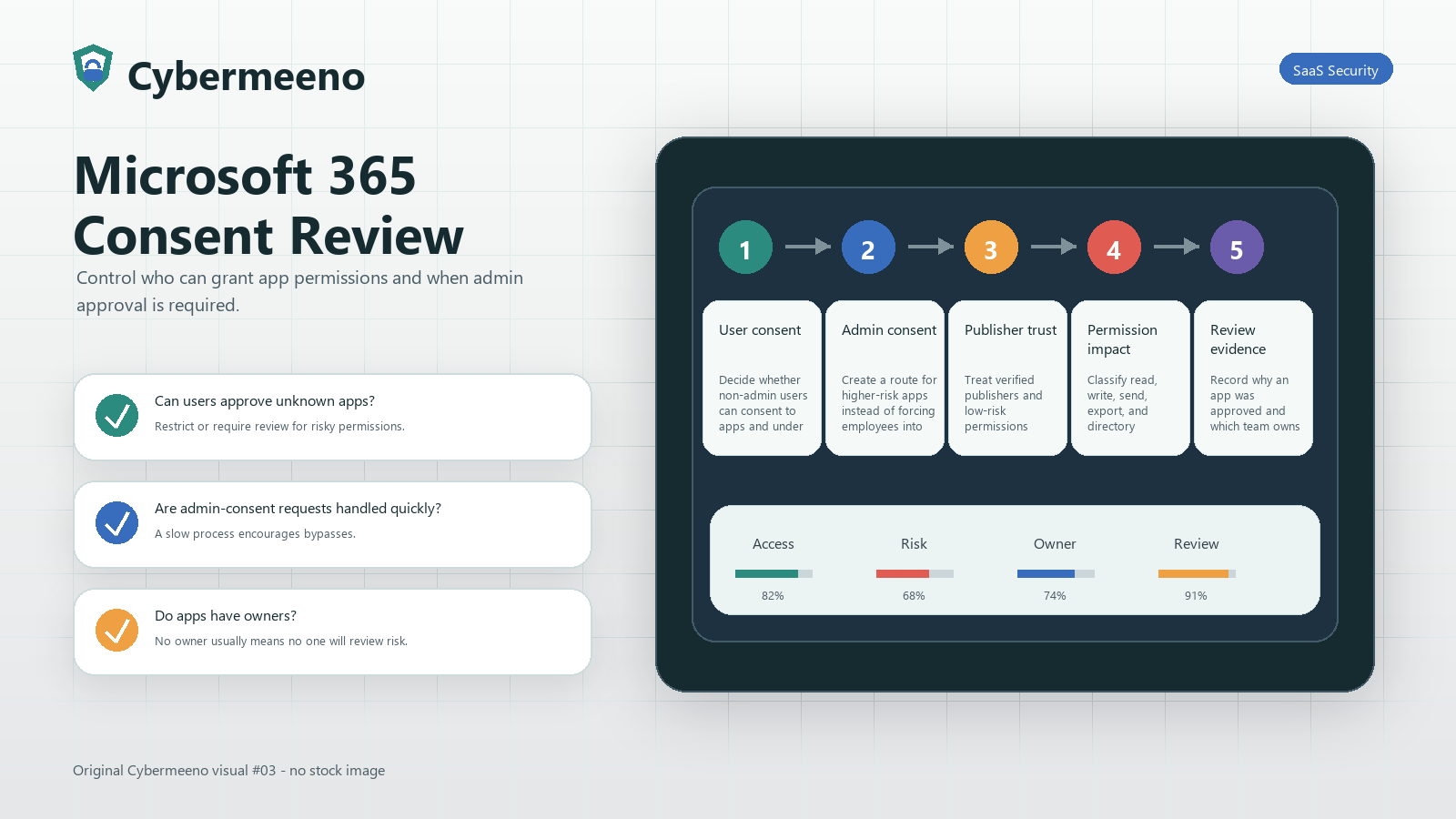
Microsoft 365 security is not only about strong passwords and MFA. The consent model matters because users may grant applications access to data and permissions that affect email, files, calendars, Teams, and identity data.
A small consulting firm signs into a proposal tool with Microsoft. It asks for permissions that look technical, so the user clicks accept. Later the tool is abandoned, but its consent remains. Consent governance exists to stop that pattern.
This guide is written for small business owners, solo founders, agencies, freelancers, and content-site operators who need a practical way to make the decision without creating an enterprise security department.
Quick Answer
If you only take one thing from this guide, take this: do not judge this topic by whether the tool, plugin, account, or workflow is popular. Judge it by what it can access, what can go wrong, who owns the decision, and how quickly you can reverse the change.
For a small business, a strong setup is usually simple:
- one accountable owner
- limited permissions
- written settings
- tested recovery
- monthly review
- no permanent access without a reason
That sounds basic, but most real failures happen because one of these pieces is missing.
Quick Decision Framework
| Area | What to do |
|---|---|
| User consent | Decide whether non-admin users can consent to apps and under what conditions. |
| Admin consent | Create a route for higher-risk apps instead of forcing employees into workarounds. |
| Publisher trust | Treat verified publishers and low-risk permissions differently from unknown apps requesting broad access. |
| Permission impact | Classify read, write, send, export, and directory permissions separately. |
| Review evidence | Record why an app was approved and which team owns it. |
The point is not to make the process slow. The point is to make the risk visible before a rushed approval becomes permanent access.
Weak Setup vs Strong Setup
| Area | Weak setup | Strong setup | Review question |
|---|---|---|---|
| User consent | Leaving default consent settings untouched forever. | Decide whether non-admin users can consent to apps and under what conditions. Restrict or require review for risky permissions. | Can users approve unknown apps? |
| Admin consent | Approving apps without checking requested permissions. | Create a route for higher-risk apps instead of forcing employees into workarounds. A slow process encourages bypasses. | Are admin-consent requests handled quickly? |
| Publisher trust | Failing to revoke consent after a trial. | Treat verified publishers and low-risk permissions differently from unknown apps requesting broad access. No owner usually means no one will review risk. | Do apps have owners? |
| Permission impact | Allowing apps to send email or access files without an owner. | Classify read, write, send, export, and directory permissions separately. If not, pause approval until someone technical reviews it. | Can permissions be explained plainly? |
| Review evidence | Leaving default consent settings untouched forever. | Record why an app was approved and which team owns it. Restrict or require review for risky permissions. | Can users approve unknown apps? |
This table is useful because it turns vague advice into a decision. If your current setup looks closer to the weak column, do not treat that as failure. Treat it as your next fix list.
Why This Matters in 2026
Small teams now run on connected tools. A blog is connected to WordPress, analytics, email, AI writing tools, cloud storage, password managers, payment platforms, social schedulers, and sometimes CRMs. Every connection creates a permission trail.
The best security programs for small businesses are not built from expensive dashboards first. They are built from clear ownership, limited access, recoverable systems, and a habit of reviewing tools before they touch sensitive data.
For this topic, the practical question is:
Can we explain what has access, why it has access, who owns it, and how we remove it?
If the answer is no, the setup is not ready yet.
Operator Case Study: How This Fails in a Real Small Business
A small consulting firm signs into a proposal tool with Microsoft. It asks for permissions that look technical, so the user clicks accept. Later the tool is abandoned, but its consent remains. Consent governance exists to stop that pattern.
The expensive part is rarely the first click. The expensive part is the quiet period after the click, when the access stays active, the data keeps moving, and nobody owns the decision anymore.
Here is how a careful operator would handle the same situation:
- Start with the business reason: Decide whether non-admin users can consent to apps and under what conditions.
- Run the first review question: Can users approve unknown apps? Restrict or require review for risky permissions.
- Run the second review question: Are admin-consent requests handled quickly? A slow process encourages bypasses.
- Decide whether to approve, limit, sandbox, or reject.
- Put a review date on the decision so it does not become permanent by accident.
This is the difference between security theater and operational security. Security theater creates rules nobody follows. Operational security creates small habits that keep working when the site grows, the team changes, or a contractor leaves.
Deep Review Matrix
Use this section when the first-pass checklist is not enough. It gives you the extra detail that separates a surface-level setup from one that can survive real operations.
| Area | What to inspect | Question to ask | Bad sign | Next action |
|---|---|---|---|---|
| User consent | Decide whether non-admin users can consent to apps and under what conditions. | Can users approve unknown apps? | Leaving default consent settings untouched forever. | Restrict or require review for risky permissions. |
| Admin consent | Create a route for higher-risk apps instead of forcing employees into workarounds. | Are admin-consent requests handled quickly? | Approving apps without checking requested permissions. | A slow process encourages bypasses. |
| Publisher trust | Treat verified publishers and low-risk permissions differently from unknown apps requesting broad access. | Do apps have owners? | Failing to revoke consent after a trial. | No owner usually means no one will review risk. |
| Permission impact | Classify read, write, send, export, and directory permissions separately. | Can permissions be explained plainly? | Allowing apps to send email or access files without an owner. | If not, pause approval until someone technical reviews it. |
| Review evidence | Record why an app was approved and which team owns it. | Can users approve unknown apps? | Leaving default consent settings untouched forever. | Restrict or require review for risky permissions. |
Decision Rules You Can Copy
Use these rules when the team is unsure whether to approve, delay, or reject a change.
| Situation | Decision |
|---|---|
| The business reason is unclear | Delay approval until the owner can explain the workflow and expected benefit |
| The setup touches sensitive customer, payment, legal, health, or financial data | Require stricter review and consider professional help |
| The tool or workflow has broad access but no owner | Reject or sandbox until ownership is assigned |
| The vendor or plugin cannot explain retention, deletion, or access controls | Do not use it with confidential data |
| The change is useful but risky | Approve with limits, a review date, and documented rollback steps |
| The team cannot test recovery or removal | Do not treat the setup as production-ready |
For this article, pay special attention to user consent, admin consent, and publisher trust. Those are the points where small teams usually move too fast.
Step-by-Step Playbook
1. Review current consent settings
Check whether users can approve apps without admin involvement. If yes, decide whether that still fits your risk level.
Implementation detail: Use one record for the decision: owner, date, scope, evidence, and next review. A simple row in a spreadsheet is enough if it is maintained.
The check to run here is: Can users approve unknown apps? Restrict or require review for risky permissions.
A weak version of this step is: Leaving default consent settings untouched forever. The strong version creates a paper trail a future admin can understand.
2. Define low-risk permissions
Some profile or sign-in permissions may be acceptable. Email, file, Teams, and directory access deserve stricter controls.
Implementation detail: Open the real settings screen and capture what is enabled. Do not rely on memory or vendor marketing copy.
The check to run here is: Are admin-consent requests handled quickly? A slow process encourages bypasses.
A weak version of this step is: Approving apps without checking requested permissions. The strong version shows the exact setting, not just the intention.
3. Create a request path
Employees need a clear way to request apps. Without a path, they will use personal accounts or shadow tools.
Implementation detail: Test with a low-risk account or folder first. If the workflow cannot be proven with test data, it is not ready for sensitive data.
The check to run here is: Do apps have owners? No owner usually means no one will review risk.
A weak version of this step is: Failing to revoke consent after a trial. The strong version proves usefulness before trusting production data.
4. Audit enterprise applications
Review apps already present, who uses them, and what permissions were granted.
Implementation detail: Prefer the narrowest access that still lets the work happen. Broad access should be the exception, not the starting point.
The check to run here is: Can permissions be explained plainly? If not, pause approval until someone technical reviews it.
A weak version of this step is: Allowing apps to send email or access files without an owner. The strong version limits blast radius if the tool or account is later compromised.
5. Revoke retired apps
If an app has no owner or business purpose, remove consent and document the cleanup.
Implementation detail: Put removal on the calendar. Access that never expires becomes part of the attack surface.
The check to run here is: Can users approve unknown apps? Restrict or require review for risky permissions.
A weak version of this step is: Leaving default consent settings untouched forever. The strong version includes cleanup, review, and an owner.
What to Check Before You Approve or Change Anything
| Check | Why it matters |
|---|---|
| Can users approve unknown apps? | Restrict or require review for risky permissions. |
| Are admin-consent requests handled quickly? | A slow process encourages bypasses. |
| Do apps have owners? | No owner usually means no one will review risk. |
| Can permissions be explained plainly? | If not, pause approval until someone technical reviews it. |
Common Mistakes
- Leaving default consent settings untouched forever.
- Approving apps without checking requested permissions.
- Failing to revoke consent after a trial.
- Allowing apps to send email or access files without an owner.
These mistakes are common because they feel small at the time. The risk appears later when the site grows, the team changes, or a tool is forgotten.
Owner Responsibility Map
| Role | Responsibility | What they should not own alone |
|---|---|---|
| Site owner / founder | Final decision, risk acceptance, budget, and review cadence for user consent | Technical settings they do not understand without help |
| Admin / developer | Configuration, access controls, logs, backups, and technical evidence for admin consent | Business approval without owner sign-off |
| Writer / operator | Day-to-day workflow, draft usage, screenshots, publishing notes, and reporting issues | Admin permissions or sensitive data approvals |
| Contractor / vendor | Only the task-specific access needed to complete work | Permanent access, shared owner passwords, or untracked API keys |
| Future reviewer | Check whether the control still works after 30-90 days | Assuming old decisions are still correct |
The most important line in this table is the final reviewer. Small sites fail quietly when old decisions never get rechecked. A tool that was safe during a trial may become risky after the team adds customer data, contractors, automations, or billing access.
30-Day Implementation Plan
Week 1: Inventory and Baseline
List the accounts, tools, users, settings, connected apps, files, and workflows that matter for this topic. Do not change everything immediately. First create a baseline so you know what exists today.
For a small team, the baseline can be a spreadsheet with the owner, tool name, access level, data touched, and next review date. The purpose is visibility. You cannot secure access that nobody remembers granting.
Week 2: Reduce the Obvious Risk
Fix the highest-impact issues first: shared admin accounts, missing MFA, unknown connected apps, weak recovery settings, unused plugins, untested backups, broad file sharing, or tools with no owner.
Do not spend the first week chasing perfect policy language. Remove the easy exposure that could create real damage.
Week 3: Document the Repeatable Process
Turn the decision into a repeatable workflow. Write down who approves changes, what evidence is checked, what data is allowed, and when the setup must be reviewed again.
The process should be short enough that the team will use it. A one-page checklist used every month is better than a long policy nobody opens.
Week 4: Review and Improve
Check whether the control actually changed behavior. Did people stop sharing passwords in chat? Did old tools get removed? Are backups restorable? Are app permissions reviewed before approval?
If the answer is unclear, simplify the process and assign one owner.
Evidence to Keep
Keep lightweight evidence for important security decisions. This helps during migrations, incidents, contractor changes, and future audits.
- screenshot of important settings
- approval note or decision record
- owner name and review date
- backup or export location
- list of users with access
- source links used for the decision
- notes from restore tests, access reviews, or vendor checks
Evidence does not need to be fancy. It needs to be findable when something breaks.
For this specific topic, keep:
- screenshot or export showing the current state of user consent
- screenshot or export showing the current state of admin consent
- screenshot or export showing the current state of publisher trust
- screenshot or export showing the current state of permission impact
Metrics Worth Tracking
Track a few numbers monthly:
- number of admin accounts
- number of unused users removed
- number of high-risk apps or plugins reviewed
- number of backups successfully tested
- number of tools without owners
- number of unresolved security tasks older than 30 days
These metrics make security operational. If a number never improves, the process is probably too vague.
When to Get Professional Help
Get qualified help if this topic touches regulated data, legal obligations, payment data, healthcare information, financial records, customer breach notification, active compromise, ransomware, or systems that cannot afford downtime.
Cybermeeno content is designed to help small businesses make better first decisions, but some situations need legal, compliance, or professional security support.